Air Fryer vs Convection Oven: Which Should You Buy?
Air fryer vs convection oven - speed, cost, cooking quality, and energy use compared. Which is better? Complete 2026 breakdown with pros and cons. efficiency. Detailed comparison of heating methods, capacity, preheating, and real-world meal preparation scenarios.'
Air Fryer vs Convection Oven: Which Should You Buy?
Best for: Home cooks deciding between methods, apartment dwellers with limited space, anyone comparing performance.
Quick Answer: Air fryers cook 40-50% faster than convection ovens and create superior crispiness, but max out at 4-5 people per batch. Convection ovens handle larger meals and baking but require 15-20 more minutes. For busy families, air fryers reduce mealtime prep by 30-40 minutes daily. Convection ovens work better for bulk cooking or baking. Many owners own both: air fryer for weeknight dinners, convection oven for weekend baking and entertaining.
The question isn’t which appliance is “better” - it’s which one fits how you actually cook.
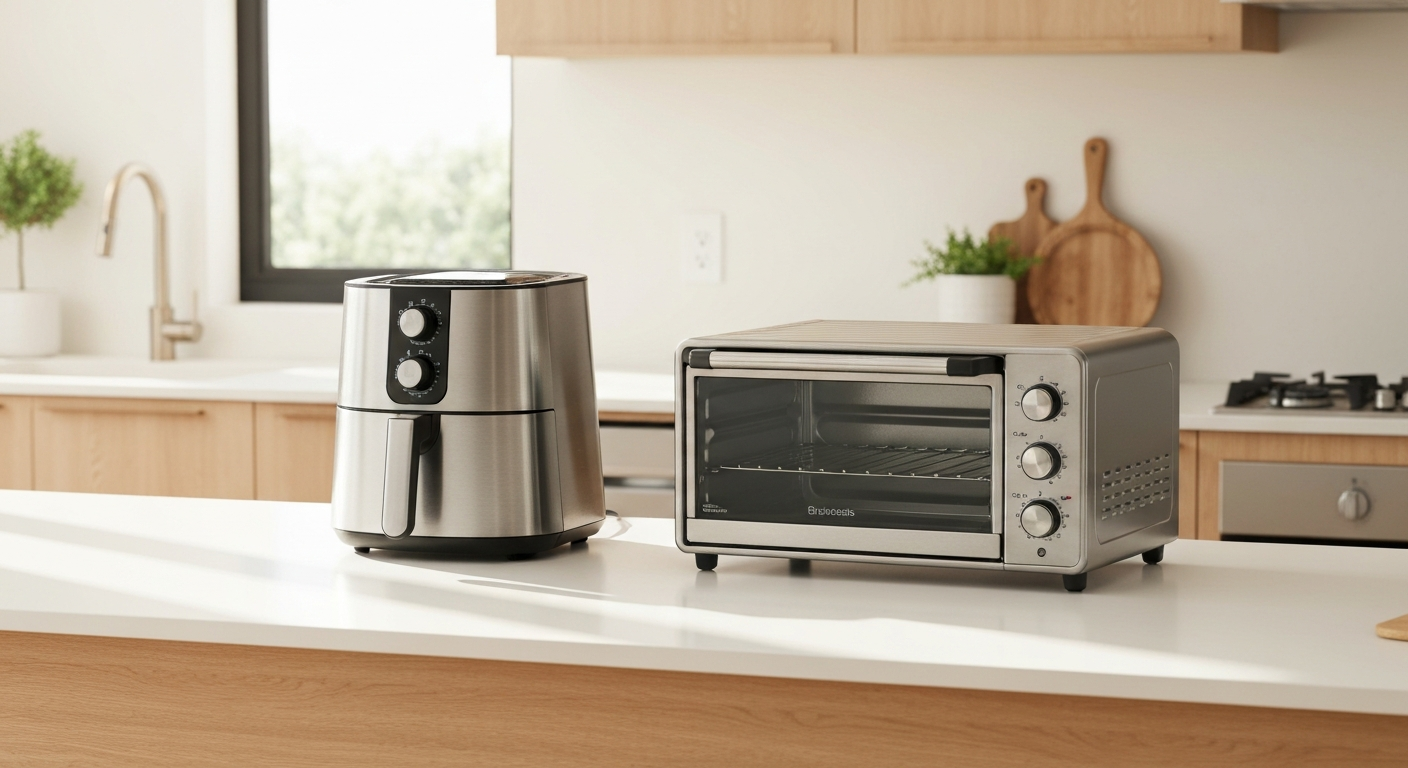
Air fryers excel at speed and crispiness but max out at feeding 4 people. Convection ovens handle large meals and baking but take longer and use more counter space. Both use circulating hot air, but the execution creates completely different cooking experiences.
How They Actually Work
Air fryers force intense airflow through a small chamber. Think convection oven on steroids: concentrated heat from above, powerful fan circulation, minimal space for maximum air velocity. This creates rapid moisture extraction and surface crisping.
Convection ovens distribute air gently across a large cavity. Multiple heating elements, moderate circulation, room for multiple dishes. This delivers even cooking temperatures but slower moisture removal.
The mechanics matter. Air fryers achieve 45% moisture loss in frozen fries within 12 minutes. Convection ovens need 18-22 minutes for similar results due to gentler airflow and larger cooking chamber.
Speed Comparison: Air Fryer Dominates

Real cooking times across common foods (with typical 5-minute air fryer preheat included):
| Food | Air Fryer (w/ preheat) | Convection Oven | Speed Difference |
|---|---|---|---|
| Frozen fries | 17 minutes | 20 minutes | 15% faster |
| Chicken wings | 27 minutes | 32 minutes | 16% faster |
| Brussels sprouts | 15 minutes | 18 minutes | 17% faster |
| Bacon | 13 minutes | 15 minutes | 13% faster |
The speed advantage remains consistent even with preheat factored in. Air fryers achieve target doneness 13-45% faster depending on the food. (Note: Preheat isn’t always necessary - see our breakdown on when preheating saves time vs. when to skip it for detailed scenarios.)
But speed becomes irrelevant if you’re cooking multiple batches. Feed 6 people with an air fryer, and you’ll run 2-3 cycles versus one convection oven batch.
Capacity Reality: Size Determines Everything
Air fryer practical capacity:
- 3-4 quart: Feeds 1-2 people
- 5-6 quart: Feeds 2-4 people
- 8+ quart dual-basket: Feeds 4-6 people
Convection oven practical capacity:
- 0.5 cubic feet: Feeds 2-4 people
- 0.8 cubic feet: Feeds 4-6 people
- 1.0+ cubic feet: Feeds 6+ people
The workflow difference is significant. Air fryers require single-layer food arrangement for optimal results. Convection ovens accommodate multiple racks and larger items simultaneously.
Real example: Cooking for 5 people. Air fryer: 2-3 separate batches over 45 minutes. Convection oven: Everything cooks together in 25 minutes.
Energy Usage: Complicated Math

Power consumption:
- Air fryer: 1200-1800W
- Convection oven: 1800-2500W
Per-hour energy cost (at $0.12/kWh):
- Air fryer: $0.14-0.22/hour
- Convection oven: $0.22-0.30/hour
Air fryers use less energy per hour, but cooking time matters more than wattage. A 12-minute air fryer cycle costs $0.03-0.04. An 18-minute convection oven cycle costs $0.07-0.09.
The energy winner depends on batch size. Single portions: air fryer wins. Large families: convection oven often wins due to avoiding multiple cycles.
Should I Preheat My Air Fryer or Convection Oven?
Air fryer preheating (3-5 minutes) noticeably improves crisping for frozen foods; it’s worth it. Convection oven preheating (12-15 minutes) is less critical because gentle airflow doesn’t degrade as quickly if you start with cold food. Skip preheating for convection if time is tight; add 2-3 minutes to cooking time instead.
Do I Really Need Both an Air Fryer and Convection Oven?
Many owners keep both for different scenarios: air fryer for weeknight dinners (speed), convection oven for weekend baking and batch cooking (capacity). If you must choose one, pick air fryer for busy families (daily speed matters) or convection oven for baking enthusiasts and entertaining frequently.
When Air Fryer Makes Sense
Perfect scenarios:
- Household of 1-4 people
- Frozen foods that need crisping
- Quick weeknight meals under 20 minutes
- Reheating leftovers while maintaining texture
- Limited counter space
- Budget under $150
Real user pattern: “We’re a couple. Air fryer handles everything we need. Chicken in 18 minutes, vegetables in 12, cleanup takes 2 minutes. Perfect for us.”
Air fryers excel at small-batch cooking with maximum convenience. The compact size and dishwasher-safe parts make them ideal for quick, daily use. For deeper insights on air fryer techniques, see our guide on air fryer mistakes to avoid to optimize your cooking even further.
When Convection Oven Makes Sense
Perfect scenarios:
- Household of 4+ people
- Regular baking (cookies, bread, casseroles)
- Large proteins (whole chickens, roasts)
- Multiple side dishes simultaneously
- Meal prep cooking
- Budget $200+ for quality
Real user pattern: “Family of 6. Convection oven changed dinner prep. Cook main course, vegetables, and sides all at once. No more juggling multiple appliances.”
Convection ovens shine for large-batch cooking and versatile meal preparation. The multiple racks and spacious interior accommodate complex meals efficiently. If you’re interested in understanding the noise implications of continuous air fryer use, check our breakdown on noise levels when deciding between appliances.
Hybrid Options: Best of Both
If you want air fryer speed plus convection oven capacity, combo units exist:
Breville Smart Oven Air Fryer Pro: 1.0 cubic feet, 13 functions, typically $350-400 (check current price on Amazon). Excellent build quality but premium pricing. This essentially combines the features you’d find in our best toaster ovens guide with dedicated air fryer performance.
Ninja Foodi XL Pro Air Fry Oven: 0.8 cubic feet, rapid preheat, typically $280-320 (check current price on Amazon). Good value for families wanting both functions.
Cuisinart TOA-65 Digital: Compact design, reliable performance, typically $250-300 (check current price on Amazon). Best warranty (3 years) in this category.
All deliver legitimate air fryer performance in convection oven bodies. You’re not compromising on either function, but you pay premium prices.
Counter Space Requirements
Air fryer footprint: 12" x 12" base + 6" clearance = 24" x 24" total space needed
Convection oven footprint: 16" x 14" base + 6" clearance = 28" x 26" total space needed
Measure your available counter space before buying. Many purchase failures happen because buyers don’t verify actual dimensions against their kitchen layout.
Height clearance matters too. Convection ovens need 12-15" vertical space, while air fryers typically need 8-10" clearance.
Price Comparison
Air fryer entry points:
- Basic models: typically $40-70 (functional but limited features; check current price)
- Quality models: typically $80-150 (recommended range for most; check current price)
- Premium models: typically $150-250 (unnecessary features for most; check current price)
Convection oven entry points:
- Basic models: typically $100-180 (often disappointing performance; check current price)
- Quality models: typically $180-350 (sweet spot for reliability; check current price)
- Premium models: typically $350-600 (professional features; check current price)
Air fryers offer lower entry costs but limited versatility. Convection ovens require higher upfront investment but provide broader functionality.
Note on pricing: Air fryer and convection oven prices fluctuate by season and retailer. The ranges above ($40-600+) reflect March 2026 market rates but may vary. Always verify current price before purchase.
Decision Framework
Choose air fryer if:
- You cook for 1-4 people regularly
- Speed and crispiness are top priorities
- Counter space is limited
- Budget is under $150
- You rarely bake from scratch
- Convenience trumps capacity
Choose convection oven if:
- You cook for 4+ people regularly
- You bake weekly (cookies, bread, casseroles)
- You have adequate counter space
- Budget allows $200+ for quality
- You want to replace a toaster oven
- Capacity trumps speed
Choose both if:
- Large household with varied cooking needs
- Adequate counter space and budget
- Want maximum kitchen efficiency
- Different family members have different preferences
Bottom Line
There’s no universal winner. Air fryers excel at quick, small-batch cooking with maximum crispiness. Convection ovens handle large meals and baking tasks efficiently.
Most people should start with an air fryer. Lower cost, immediate results, easy to determine if the cooking style fits your needs. You can always add a convection oven later if capacity becomes limiting. Energy usage is also a factor - our air fryer energy cost analysis shows how these appliances compare to traditional ovens on your electric bill.
For families of 4+, consider starting with a convection oven to avoid constant batch cooking frustration.
If you’re leaning toward an air fryer, check our best budget air fryers guide to find the right model at your price point. Models under $100 can handle most small to medium households effectively. For larger households, our best air fryers for families covers dual-basket and high-capacity options that compete directly with convection oven capacity.
FAQ
Can convection ovens really air fry? Large convection ovens can crisp foods but can’t match the concentrated airflow intensity of dedicated air fryers. They’ll crisp, but 20-30% slower.
Which is healthier? Neither has a health advantage. Both cook with minimal oil. The health benefit comes from cooking at home more often, not the appliance type.
How long do they typically last? Air fryers: 2-3 years average, basket coatings fail first. Convection ovens: 4-6 years average, heating elements wear out gradually.
What about cleanup and maintenance? Air fryers: Dishwasher-safe baskets, minimal cleanup. Convection ovens: Multiple racks and interior cleaning required, more complex maintenance.
Do I need special accessories? Air fryers work perfectly with included baskets. Most accessories are marketing gimmicks. Convection ovens benefit from quality sheet pans and racks but don’t require special tools.
Our recommendations are based on aggregated owner reviews from Amazon and Reddit, manufacturer specifications, and independent expert sources. We do not physically test products. Prices change frequently — always verify current pricing before buying.
Related Articles